The FitnessGram PACER test is a shuttle run used in school PE. You run back and forth between two lines, usually 20 metres apart, and you have to reach the far line before the next beep. The beeps start slow and come closer together in steps, so the running gets faster until you cannot keep up. PACER stands for Progressive Aerobic Cardiovascular Endurance Run.
Your score is simply how many laps you made. One lap is one trip from one line to the other. The first time you miss the line, you turn and keep going. The second time, you are done, and that lap count goes on your report.
The short version Run to the line before each beep. One trip is one lap. Miss once and keep going; miss a second time and your test ends. Your score is the number of laps you completed.
What the PACER test is
The PACER is FitnessGram’s version of the 20m multi-stage shuttle run, the same family as the beep test or bleep test used by sports clubs. A whole class can run it together, which is why so many schools use it instead of a timed mile.
It looks like the beep test from the side of the gym, but the number you take home is different. Clubs usually write a beep test result as level and shuttle, such as 9.6. The PACER usually counts laps, such as 41. Why those two numbers do not convert into each other is covered in PACER vs the beep test.
How the FitnessGram PACER test runs, lap by lap
Everyone lines up behind one line. Most PACER recordings start with a spoken explanation before the first beep, so listen to it rather than talking over it: it tells you the rules you are about to be held to.
- Start on the beep. Run to the other line and get there before the next beep. If you arrive early, wait at the line. Leaving early does not earn anything.
- Turn at the line. Touch or cross it with your foot, turn and wait for the beep. A turn short of the line does not count as a lap.
- Keep up as it speeds up. The gap between beeps gets shorter in steps.
- First miss. If the beep goes before you reach the line, turn around where you are and head back. You have a chance to catch up.
- Second miss. The test is over for you. Step out of the lane carefully and tell the person counting.
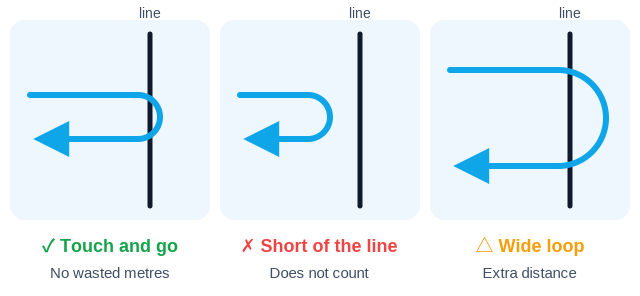 Reach the line, turn tight, go. A turn short of the line is not a lap.
Teachers do not all count misses the same way. Some end the test after any two misses, and some only after two in a row. Ask before you start, not after.
PACER test scoring: laps, not levels
Your score is the number of laps you completed before your second miss. A partner or your teacher usually keeps the count, often on a score sheet with a box for each lap, and marks where your misses happened.
On the 20m version, laps also tell you distance: each lap is 20 metres, so 40 laps is 800 metres. That is a handy way to see your progress, but it is not a conversion to a beep test level.
Schools that use FitnessGram usually compare your laps with standards for your age and sex, and your report shows where you landed. Those standards come from your school’s FitnessGram set-up, not from a chart on a forum, so ask your teacher which ones they use. Treat any comparison as a reference point for your own next attempt, not a verdict on your health.
PACER test distance: 20 metres or 15 metres
The standard PACER lane is 20 metres between the two lines, about 21.9 yards or 65.6 feet. Not every gym fits that with room to stop, so FitnessGram also has a 15 meter PACER test, about 16.4 yards, with its own audio.
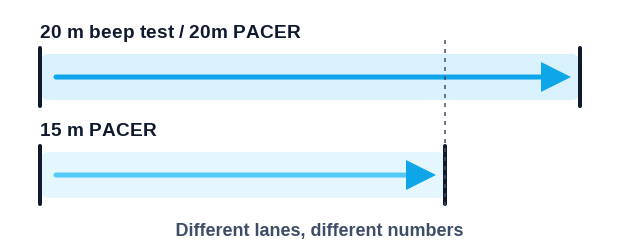 The 15m PACER lane is a quarter shorter, so 15m laps are not 20m laps.
The two versions give different lap counts for the same runner, so a 15m result is not directly comparable with a 20m one. If you practise, measure the same lane length you will be tested on. A basketball court may or may not give you a clean 20 metres, so use a tape rather than the court lines. More on lane lengths in yards and feet is in beep test distance.
How to practise for the PACER test at school
You do not need to run the full test every day. It is a maximum effort, and doing it too often mostly makes you tired. A few things help more:
- Practise the turn. Touch the line, turn tight, and be ready to go. Lost time at the turn adds up across a long test.
- Pace the early laps. The first laps feel easy, and it is tempting to sprint them. Arriving just before the beep saves energy for the later, faster steps. How to improve your beep test score has more on pacing, and it works the same way here.
- Use a measured lane. Practise on the distance your school uses. If you train at 20m and your gym runs 15m, the turns will come sooner than you expect, and the other way round.
- Write down each attempt. Laps, date and lane length. Comparing like with like is how you see whether you are getting fitter.
If you practise with BeepRun, know what it is: it plays the 20m beep test (bleep test) audio, counts shuttles and levels, and keeps your records. It is not the licensed FitnessGram PACER recording, so the rhythm will be close but not identical. The running fitness carries over; the exact cadence of your school’s track does not.
On the day of the PACER test
Do not run on a full stomach, wear shoes you can turn in, and warm up properly. This beep test warm-up works just as well before a PACER: a few minutes of easy movement and some practice turns.
During the test, run your own pace, not your friend’s. Listen for the beep rather than watching the runners next to you, because they may be on a different lap. When you are out, move to the side so nobody runs into you, and check that the lap count written down is yours.
The PACER is hard work by design. If you feel dizzy, sick or unwell, stop and tell your teacher. If you have a medical condition, talk to a doctor before you run it.
Quick answers
What is the FitnessGram PACER test?
It is the shuttle run used in FitnessGram school fitness testing. You run between two lines, usually 20 metres apart, and reach each line before the beep. The beeps get faster in steps, and you keep going until you cannot make the line in time.
How is the PACER test scored?
Your score is the number of laps you completed, where one lap is one run from one line to the other. The first time you do not reach the line, you turn and carry on. The second time, the test is over and your laps are written down.
How far is the PACER test, and is there a 15 meter version?
The standard lane is 20 metres, about 21.9 yards. Gyms that are too short can use a 15 metre version, about 16.4 yards, with its own audio. Lap counts from the two versions are not the same, so check which one your school runs.