The beep test for soccer is the same 20m multi-stage shuttle run used in schools: run between two lines 20 metres apart, reach each line before the beep, and keep going as the levels speed up. Soccer and football teams use it because a whole squad can run it at once, on one field, with nothing more than cones and a speaker.
Your result is written as level and shuttle, such as 10.4. There is no universal “good score” for soccer players. Your coach or programme sets the number they want, so the most useful thing you can do is find out that number, the audio they will play and the surface you will run on, then practise on the same set-up.
The short version Ask your coach three things: which level they expect, which audio they use, and whether you will run on grass or indoors. Then practise on a measured 20m lane with that audio.
Why soccer coaches use the beep test
The protocol is cheap and repeatable. Every player hears the same beeps, runs the same 20 metres and gets a score that can be compared with the same test a few months later. A coach can line up the whole squad across one end of the field and test everyone in a single run, instead of timing players one by one.
It also asks for things a match asks for: repeated turns, changes of speed and keeping going when you are tired. That does not make it a measure of how well you play. It is one number about running fitness, recorded under fixed rules. The rules themselves, including when you are out, are in how the 20m beep test works.
Beep test scores for soccer players: ask for the number
Search for beep test soccer scores and you will find charts by position, by age and by league. They rarely say which audio, which surface or which stopping rule they used, so they are hard to compare with the test you will actually sit.
What counts is the target your own team sets. Some programmes give one level for the whole squad. Some set different levels by position or age group. Some only want to see you improve on your last preseason. Ask before the test, not after.
When you get your result, read it the usual way. A 10.4 is level 10, shuttle 4, not “ten point four”. If your coach records total distance instead, that is shuttles completed times 20 metres: a 10.4 on the usual audio is about 87 shuttles, or about 1,740 metres. The full tables are in beep test levels and beep test distance.
Running the beep test on a soccer field
Grass works if it is dry, flat and cut short. Wet or long grass makes every turn slower and riskier, and you will feel it most in the later levels.
Do not borrow a pitch line and hope it is close enough. Measure 20 metres with a tape, then lay a row of cones along each end so every player has a clear line to reach. The 20 metres is between the two lines, which is about 21.9 yards if your tape is in imperial units. Leave clear space behind each line for stopping, and enough room between players that nobody turns into a teammate.
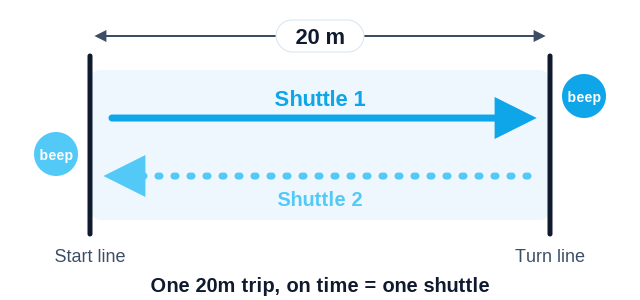 Measure 20 m from line to line. One trip across the lane is one shuttle, for every player in the row.
Footwear matters more on grass than in a gym, and your team may tell you whether to wear boots or trainers. Practise turning in whatever you will wear on the day, because the turn is where most shuttles are lost.
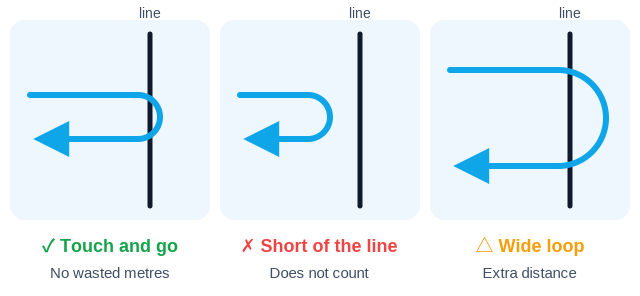 Reach the line, turn tight, go. A turn short of the line is a missed shuttle.
The general checklist for lanes, floors and counting is in how to set up a beep test.
Beep test soccer audio: practise with your team’s track
Recordings differ slightly in timing, and a track made for a 15m lane will not fit a 20m one. If you can find out which version your coach plays, practise with that. If you cannot, use a standard 20m track and expect the rhythm on the day to feel a little different. Beep test audio explains what to check before you press play.
Play it loud enough to hear across a field. Outdoors, wind and other players’ footsteps drown out a phone speaker faster than you would think.
Beep test or Yo-Yo test?
Some teams use the Yo-Yo tests instead of, or as well as, the beep test. They are a separate family with their own audio and their own rules, and coaches sometimes call any of them “the beep test”. The scores do not convert into each other.
So if a coach says “beep test”, check whether they mean the 20m multi-stage shuttle run on this page. If it is a Yo-Yo test, practise with that test’s own audio.
Getting ready in preseason
Most college soccer and club preseasons announce the test in advance. Use that time on the parts you can control:
- Run one practice test early. Same 20m, same audio, same kind of surface. Write down level.shuttle so you have a starting point.
- Pace the first levels. Reaching the line early earns nothing, because you wait for the beep. Arrive just before it and save the energy for later. How to improve your beep test score covers pacing and turns in more detail.
- Do not run a full test every day. It is a maximum effort. Repeat it every few weeks on the same set-up and compare, using a simple log of each run.
None of this guarantees a result. It means that on the day, the lane, the audio and the turns are familiar, and only the running is left.
On test day
Warm up properly before the first beep. This beep test warm-up covers a few easy minutes of movement and some practice turns, and you can fit it into the squad’s own warm-up. Ask how misses are counted, because some coaches give a warning first and some do not. When you drop out, tell the person counting straight away so your level.shuttle is written down correctly.
If you are practising alone or with one partner, BeepRun plays the beeps, counts shuttles and levels, and keeps the record so you can compare sessions. Its AR view can help you mark about 20 metres on the grass, but treat that as a guide and use a tape for a test that counts. It does not watch your feet, so be honest about the line.
A full test is hard work. If you feel unwell, skip it, and if you have a medical condition, talk to a doctor or qualified coach before you run.
Quick answers
What is a good beep test score for soccer?
There is no single standard. Each club, school or college programme sets its own target, sometimes per position or age group. Ask your coach which level they expect and which audio they use, then judge yourself against your own last result.
Can you do the beep test on a soccer field?
Yes, if the grass is dry and flat. Measure 20 metres with a tape rather than borrowing a pitch line, mark both ends with cones, and try a few turns in the footwear you will test in.
Is the beep test the same as the Yo-Yo test?
No. The Yo-Yo tests are a separate family with their own audio and rules, and some teams loosely call both “the beep test”. The scores do not convert, so ask which one you will run.