The beep test (bleep test) is run between two lines 20 metres apart. That is about 21.9 yards, or 65.6 feet. One trip from one line to the other is one shuttle, and every shuttle is the same 20 metres from level 1 to the end.
How far you run in total is a different question. It depends on how many shuttles you complete before you stop. On the usual 20m tape, finishing level 5 is roughly 820 metres, finishing level 10 roughly 1,900 metres, and finishing level 15 roughly 3,220 metres.
The short version The lane is 20 m (about 21.9 yd). Your total distance is shuttles completed × 20 m.
The beep test lane: 20 metres in metres, yards and feet
The standard multi-stage fitness test uses a 20m lane. If your tape or field markings are in imperial units, these are the same distance:
| Lane | Metres | Yards | Feet |
|---|---|---|---|
| Standard beep test | 20 m | about 21.9 yd | about 65.6 ft |
| 15m school version | 15 m | about 16.4 yd | about 49.2 ft |
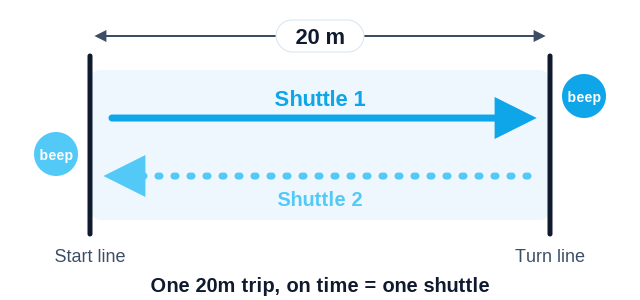 The lane is measured from line to line. One trip across it is one 20m shuttle.
The 20 metres is between the two lines, not between the cones you put beside them. Measure from the edge of one line to the edge of the other, and put a cone at each end of both lines so you can see where the lane is when you are tired. Leave a few metres of clear floor behind each line for stopping.
A lane that is a metre short does not feel like much on level 2. Over 80 or 100 shuttles it adds up, and it makes that score impossible to compare with a properly measured test. How to set up a beep test covers measuring, the floor and the audio in more detail.
Total distance per level
A level lasts about a minute, and the speed goes up every level, so later levels pack in more shuttles. The shuttle counts below are the usual Léger-style pattern from beep test levels. Recordings differ by a shuttle here and there, so treat the distances as approximate.
| Level | Shuttles in level | Distance in level | Total at end of level |
|---|---|---|---|
| 1 | 7 | 140 m | 140 m |
| 2 | 8 | 160 m | 300 m |
| 3 | 8 | 160 m | 460 m |
| 4 | 9 | 180 m | 640 m |
| 5 | 9 | 180 m | 820 m |
| 6 | 10 | 200 m | 1,020 m |
| 7 | 10 | 200 m | 1,220 m |
| 8 | 11 | 220 m | 1,440 m |
| 9 | 11 | 220 m | 1,660 m |
| 10 | 12 | 240 m | 1,900 m |
| 11 | 12 | 240 m | 2,140 m |
| 12 | 13 | 260 m | 2,400 m |
| 13 | 13 | 260 m | 2,660 m |
| 14 | 14 | 280 m | 2,940 m |
| 15 | 14 | 280 m | 3,220 m |
| 16 | 15 | 300 m | 3,520 m |
| 17 | 15 | 300 m | 3,820 m |
| 18 | 16 | 320 m | 4,140 m |
| 19 | 16 | 320 m | 4,460 m |
| 20 | 17 | 340 m | 4,800 m |
| 21 | 17 | 340 m | 5,140 m |
If you have seen a chart online with slightly different totals, that is usually because it was made for a different recording. The arithmetic is always the same: shuttles times 20.
How to work out your own distance from your score
A beep test score like 10.4 means level 10, shuttle 4. To turn it into metres:
- Find the total at the end of the last level you finished. For 10.4, that is level 9: about 1,660 m.
- Add the shuttles you completed in your final level, times 20. Four shuttles is 80 m.
- Add them together: about 1,740 m.
Only count shuttles you reached on time. Under the usual rule, a missed line is a warning and a second miss in a row ends the test, and your score is the last shuttle you made before the beep. How the 20m beep test works explains that rule.
If you run with BeepRun, it counts shuttles, levels and distance from the audio as you go and saves them with the session, so you do not have to do the sum yourself. It counts from the beeps, not from your feet, so reaching the line is still up to you.
Why distance matters less than the score
Distance is a nice number to know, but the score is what teams and schools record. Two people can cover similar distances and feel very different, because the last few levels are run much faster than the first.
Distance is most useful as a check on your setup. If your lane, your audio and your counting are the same every time, the distance and the score move together. That is what makes progress worth tracking.
15m tests and other lanes
Some gyms are too short for 20 metres, so a few school programmes use a 15m version with its own audio. Those scores are not the same as a 20m beep test, and you cannot convert one to the other by scaling the distance. The difference is covered in PACER vs the beep test, and how the 15 metre lane fits into a school session is in the FitnessGram PACER test guide.
If your test is official, ask which lane length and recording will be used, then train on exactly that. If you feel unwell during any run, stop. Distance is not worth a bad day.
Quick answers
How long is the lane in a beep test?
Twenty metres from line to line, which is about 21.9 yards or 65.6 feet. Some school versions use a 15m lane instead, and those scores do not match a 20m test.
How far do you run in a beep test?
It depends on where you stop. Every shuttle is 20 metres, so your total distance is the number of shuttles you completed times 20. On the usual tape, reaching the end of level 5 is roughly 820 metres and the end of level 10 roughly 1,900 metres.
How do I work out my beep test distance from my score?
Add up the shuttles in every level you finished, add the shuttles from your last level, then multiply by 20. A score of 10.4 on the usual tape is about 87 shuttles, or about 1,740 metres.