There is no secret session that adds a level. What most people can change is how much energy they waste before the hard part starts. This page is about that, and it does not promise a result.
The three habits
- Reach the line just before the beep in the early levels
- Touch the line and turn straight away
- Practise with the audio you will hear on the day
Pace the early levels
Level 1 starts around 8.5 km/h, which is a gentle jog. It feels too easy, so people push.
Pushing earns nothing. If you reach the line before the beep, you wait. The shuttle counts the same either way, so the early speed is spent for free. Aim to arrive just ahead of each beep and keep something in reserve for the levels where the gaps close up.
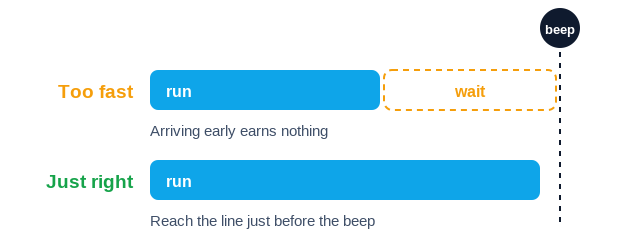 Arriving early earns nothing. Aim to reach the line just before the beep.
Keep the turn tight
Touch or cross the line with a foot, then turn and go. If you turn short of the line, that shuttle is missed. If you swing wide past it, you run extra distance every time.
Decide on your turning step early, while the levels are slow, so it is automatic later. A floor that lets your shoe grip makes a real difference. A slippery one makes every turn a small loss.
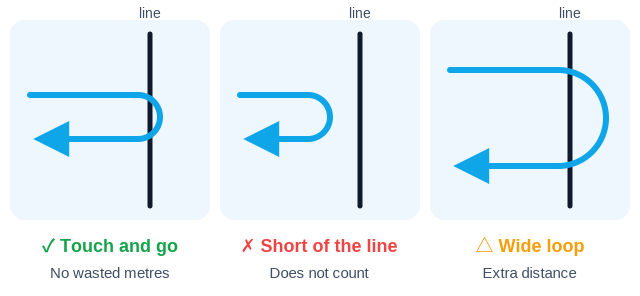 Touch the line, turn tight, go. Short turns do not count; wide loops add distance.
Practise with the audio you will use
The timing can differ slightly between recordings, so use the same audio in practice that you will use on the day, if you know it. You get used to the rhythm, and fewer beeps surprise you. If you are not sure which track to practise with, this page on beep test audio covers how the levels sound and why a 15m track will not fit a 20m lane.
Counting while you run is a distraction. BeepRun counts shuttles and levels from the audio for you, and keeps sound going with the screen off. Measure the 20m with a tape where you can. BeepRun’s AR gives a guide to about 20 metres, not an official measurement.
Compare like with like
A score only tells you something if the conditions match. Same 20m, same audio, a few weeks apart. Heat, floor and sleep move the number too, so one bad day is not a trend. A short log of each run makes that comparison easier to trust.
For the rules of the run itself, see how the 20m beep test works. For what level.shuttle means, see beep test levels.
A full test is a maximum effort, so warm up first. If you feel unwell, skip it.
Quick answers
Should I run fast in the early levels to bank shuttles?
No. If you reach the line early you wait for the beep, so extra speed earns nothing. Arrive just ahead of the beep and save the energy for later levels.
What matters most on the turn?
Touch or cross the line, turn, and go. Turning short counts as a miss, and swinging wide adds distance you have to cover.
Can an app guarantee a better score?
No. An app can keep time and count shuttles so you can compare sessions, but it cannot promise a result. Your score depends on you, the day, and the floor.